


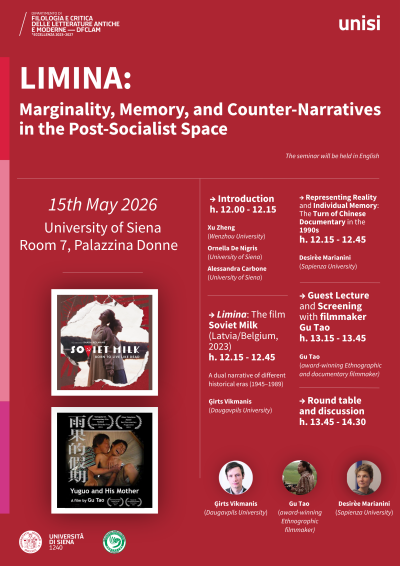
Limina: Marginality, Memory, and Counter-Narratives in the Post-Socialist Space
Friday, 15 May, h. 12 - Room 07 (Palazzina Donne)
Siena University - Pionta Campus in Arezzo
The Limina seminar explores marginality not only as a geographic or social condition but as an epistemic and linguistic position from which to observe and challenge the hegemonic narratives of socialist and post-socialist 20th-century history. Through a dialogue between Soviet Latvia and reform-era China, the seminar focuses on threshold spaces (limina) where identity, memory, and language intersect. In these contexts, marginality is not only the periphery of power but also a site for producing alternative discourses, often in tension with official languages and rhetoric.
The film Mātes piens (Soviet Milk), based on the novel by Nora Ikstena, portrays the trauma of Soviet rule through a narrative where body and language overlap: silence, censorship, and the internalization of ideological discourse create a communicative fracture between generations. Linguistic marginality—between Latvian and Russian, between private and public speech—thus becomes an integral part of the colonial experience.
Similarly, Chinese documentary filmmaking of the 1990s redefined the relationship between image and language: the use of xianchang (“what happens in front of the camera”) reduces discursive mediation and foregrounds vernacular language, dialects, silences, and hesitation. In the work of Gu Tao, language is not only a medium of communication but also an index of belonging and marginality: the voices of ethnic minorities, often excluded from standard Mandarin, carry alternative memories and worldviews. Across both contexts, tensions emerge between: official language and lived language, institutional narration and individual storytelling, visibility and silence.
Marginality thus also takes the form of a linguistic condition: to speak “from the margins” often means using minority, hybrid, or non-standard languages—or resisting the dominant language through silence, ambiguity, or fragmentation. Situated at the intersection of Slavic and Sinology studies, Limina proposes a comparative perspective in which marginality emerges as a critical site of resistance—political, cultural, and linguistic—capable of challenging boundaries between center and periphery, voice and silence, history and memory.
